Here’s the thing most articles about this question get wrong: you’re not actually trying to hire a designer. You’re trying to grow.
You want more leads, faster campaigns, stronger branding, and marketing that finally looks like the business you’re building. A designer is just one possible path to that. So the real question isn’t “Who should design this?” It’s “How do we build the creative capacity to grow—without the cost, risk, or overhead of getting it wrong?”
There are three common answers: hire someone in-house, engage an agency, or sign up for a design subscription. Each one solves a different problem. Each one costs very differently than the sticker price suggests. And the model that’s right for a funded startup is almost never the right one for a 40-person company with a busy marketing team.
This guide breaks down all three—real costs, honest pros and cons, and which model delivers the best return at each stage of growth. By the end, you’ll know exactly where your business fits and what to do next.
Let’s get into it.
What’s the difference between a design subscription, an agency, and an in-house designer?
Quick answer before we go deep:
A design subscription is ongoing creative capacity for a flat monthly fee. You send work, it gets done, you scale up or pause as needed. The best versions of this model behave less like a vending machine and more like a creative team you don’t have to employ.
An agency is a project partner. You bring a big initiative–a rebrand, a website, a campaign–and a team executes it at a high level. Great for depth. Less great for the steady stream of smaller things you need every week.
An in-house designer is an employee. You get someone embedded in your team and your brand, but you also carry the full weight of salary, benefits, software, management, and the ceiling of one person’s skill set.
Most growing businesses don’t need just one of these. They need the right one for where they are right now–and the flexibility to change as they grow.
Why creative capacity has become a growth bottleneck
Not long ago, businesses could get by with a logo, a website, and the occasional marketing piece. Today, creative demands are constant.
Marketing has changed, and the demand for creative has exploded. Today you’re not feeding one channel–you’re feeding content across many. Your business needs to show up consistently across a website, email, paid ads, organic social, sales decks, landing pages, case studies, and whatever new platform demands attention this quarter.
Three forces are squeezing every growing business at once:
- More channels. Each one wants its own format, its own sizing, its own creative rhythm.
- More content, faster. Campaigns that used to run for a quarter now turn over in a week.
- Higher standards. Your audience compares your brand to companies far larger than you–and judges accordingly.
The result is a quiet bottleneck. The strategy is ready, the campaign is approved, the launch date is set–and everything stalls because nobody has the capacity to make it look like it should. Growth doesn’t slow down because of bad ideas. It slows down because there’s no one to build them.
So businesses reach for the obvious fix: hire an in-house designer. Sometimes that’s right. Often it’s expensive in ways nobody warns you about.
Design subscription vs hiring a designer
Hiring feels like the responsible move. A real person, on your team, who knows your brand. But the true cost of that hire is rarely what you think it is.
What does it actually cost to hire an in-house designer?
The salary is just the entry fee. Here’s the fuller picture for a single mid-to-senior designer in 2026:
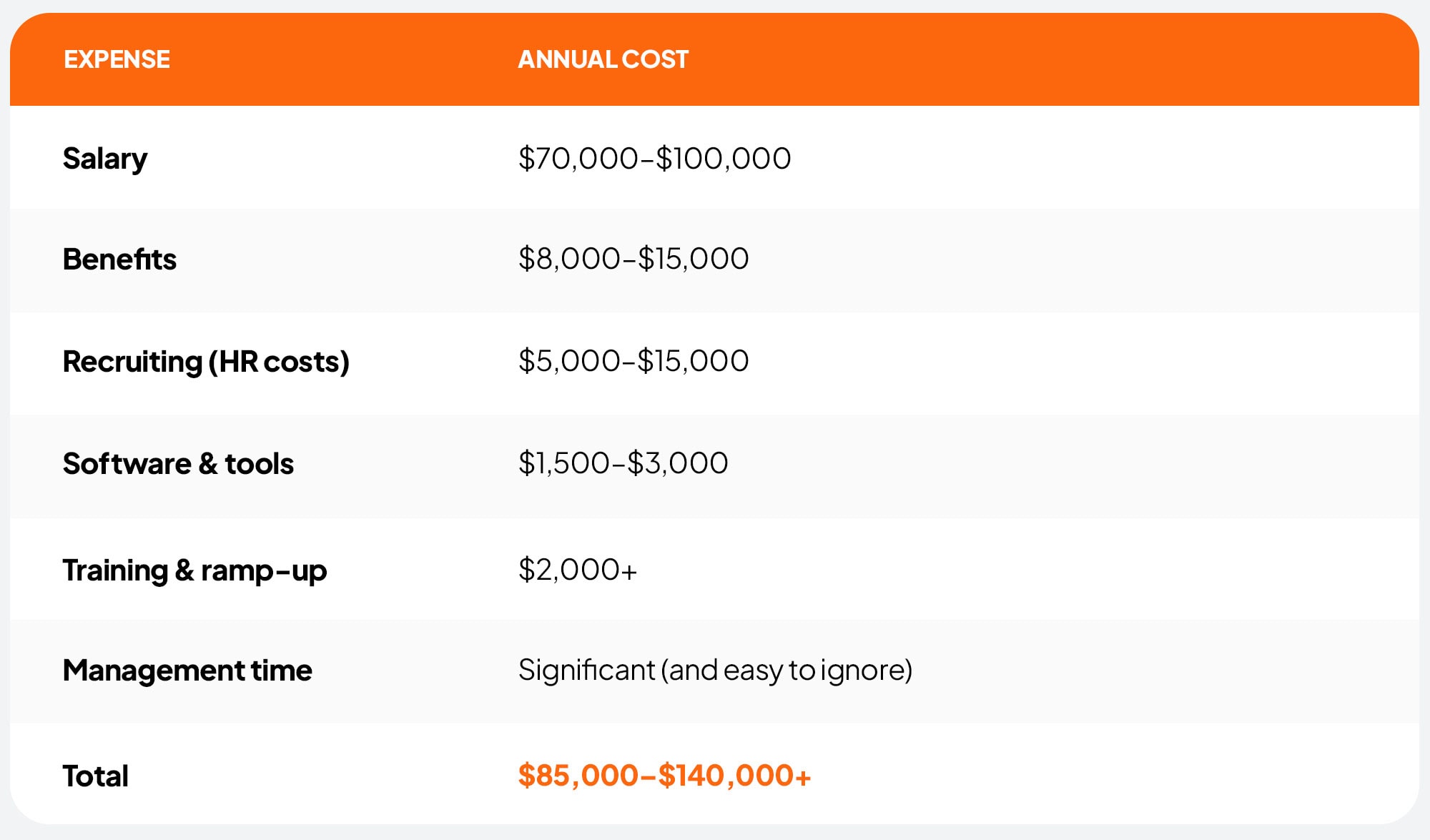
And that’s for one person–one skill set, one creative perspective, one set of working hours. The designer who’s brilliant at brand identity may be average at web, weak at motion, and not a strategist at all. You’ve hired a specialist and asked them to be a whole department.
Pros of hiring in-house
- Deep brand knowledge. Over time, they learn your business inside out.
- Always available. No queue, no waiting–work happens in real time.
- Cultural fit. A good hire becomes a true teammate, not a vendor.
- Tight feedback loops. Quick revisions, hallway conversations, shared context.
Cons of hiring in-house
- High fixed cost. You pay the same whether you have one project or twenty.
- Single point of skill. No one person covers branding, web, motion, and strategy well.
- Management overhead. Someone has to lead, review, and grow them.
- Capacity ceiling. When work spikes, one designer can’t simply become three.
- Risk if they leave. Your brand knowledge walks out the door with them.
Best use cases for an in-house designer
Hiring makes sense when your design needs are constant, high-volume, and predictable–the kind of steady workload that genuinely fills a full-time role. Think product companies with ongoing UI work, large content operations, or businesses where design is core to the product itself. If you can keep a designer busy and well-managed every day, an in-house hire earns its cost.
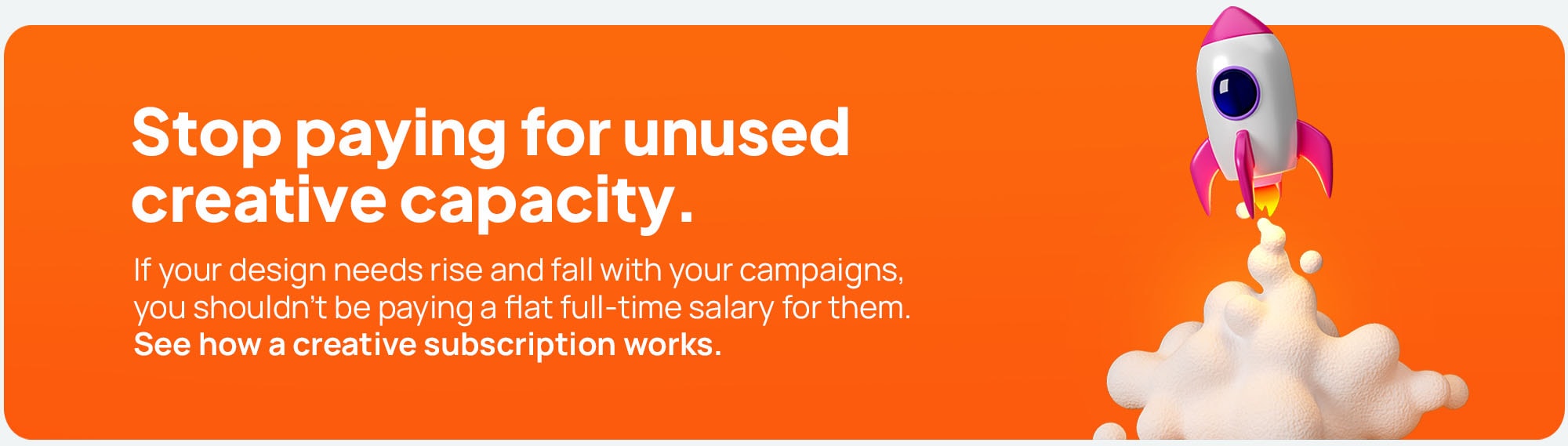
For most growing businesses, though, the workload is lumpy–busy one month, quiet the next. Paying full-time rates for part-time demand is how creative budgets quietly bleed. And mismanagement or a lack of oversight of design resources can lead to both lower productivity and quality.
Agency vs in-house design team
If hiring feels too rigid, the next instinct is to call an agency. And for the right kind of work, agencies are worth every dollar.
Agency benefits
- Strategic firepower. A good agency starts with your business goals, not your color palette.
- Full teams, not single players. Strategists, designers, writers, and developers in one place.
- High-end execution. Built for the big, brand-defining moments.
- Outside perspective. They see your business clearly because they’re not buried inside it.
Agency drawbacks
- Project-shaped, not ongoing. Agencies are built for initiatives, not the weekly drip of marketing creative.
- Cost per project adds up fast. Great for a launch, painful for steady support.
- Scoping friction. Every new request can mean a new estimate, a new timeline, a new negotiation.
- You may not get the seniors. At larger shops, the people who win your business aren’t always the ones doing the work.
Real agency cost breakdown
Project pricing varies widely by scope and seniority, but here’s a realistic range for common engagements:
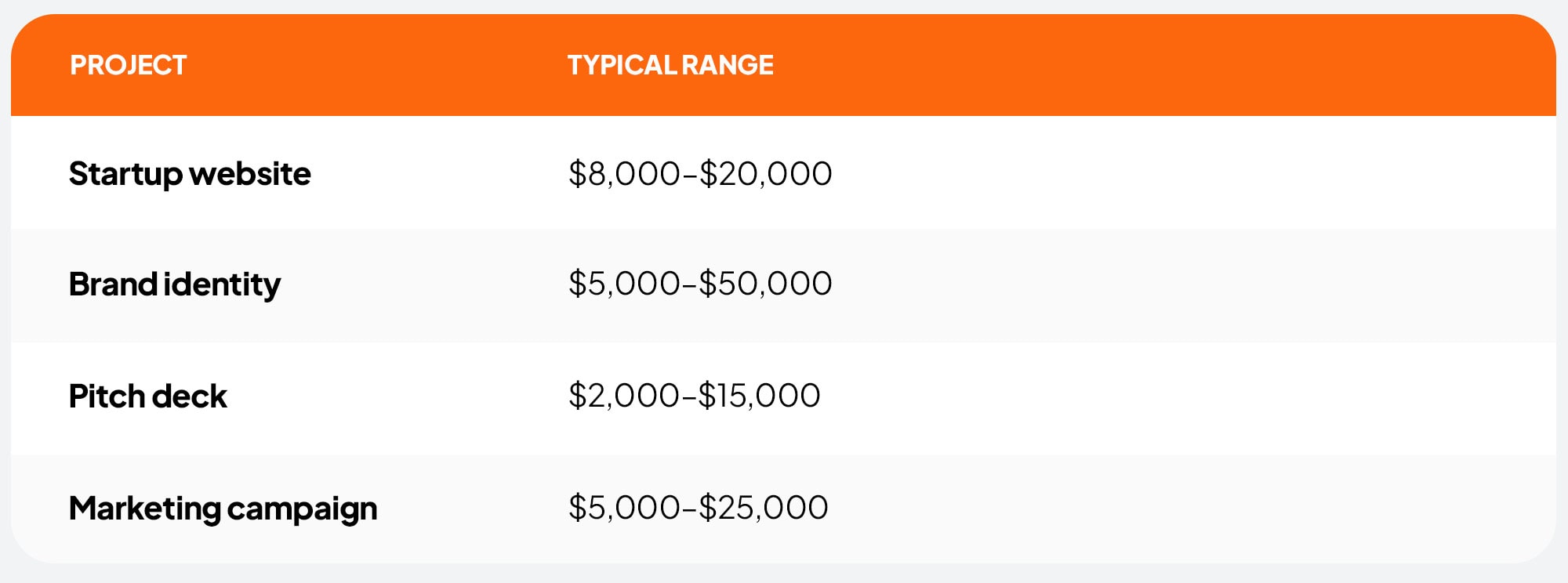
These numbers make sense for defining moments. The problem is that growth isn’t made of defining moments–it’s made of the hundred smaller things in between. Pay agency project rates for every one of those, and the math stops working.
This is the gap. In-house is great for steady work but expensive and capped. Agencies are great for big projects but clumsy for ongoing needs. A lot of businesses live exactly in the middle–and that’s where the subscription model was built to fit.
What is a design subscription?
A design subscription is ongoing creative support for a flat, predictable monthly fee. Instead of hiring a person or scoping a project, you get continuous access to creative capacity–and you scale, pause, or shift focus as your business demands.
But “design subscription” covers three very different things, and the differences matter a lot.
1. The queue model. You submit requests into a queue, and designers pull from it one at a time. Fast and affordable for high-volume, lower-complexity work–social graphics, ad variations, simple edits. The tradeoff: little strategy, rotating designers, and limited brand continuity.
2. The dedicated designer model. You’re matched with one designer for your account. More consistency than a queue, but you’re once again leaning on a single person’s range–and you inherit the same ceiling as an in-house hire, just outsourced.
3. The fractional creative team model. You get a team–strategy, branding, web, and marketing creative–working as an extension of your business, led by senior creatives who actually understand growth. This is the model that behaves like the creative department you’d build if you had unlimited budget, minus the headcount.
That last model is the one most growing businesses are quietly looking for. It pairs the steadiness of in-house, the depth of an agency, and the flexibility of a subscription–without the downside of any one of them.
Is an unlimited design subscription worth it?
It depends entirely on the shape of your demand. Here’s the honest cut:
It’s worth it if:
- You’re marketing-heavy and produce creative every week
- Your team is growing and your needs keep expanding
- You run frequent campaigns across multiple channels
- You want predictable costs instead of surprise invoices
- You need range–brand, web, and marketing–not just one skill
It’s not worth it if:
- You need a one-time logo and nothing more
- You have no ongoing creative needs
- You require deep enterprise governance and procurement layers
- Your work is rare, massive, and entirely project-based
The word “unlimited” gets oversold. What actually matters isn’t infinite output–it’s reliable output, done well, by people who understand your brand. A subscription earns its keep when it replaces the chaos of one-off freelancers and the expense of a full hire with something steady you can build on.
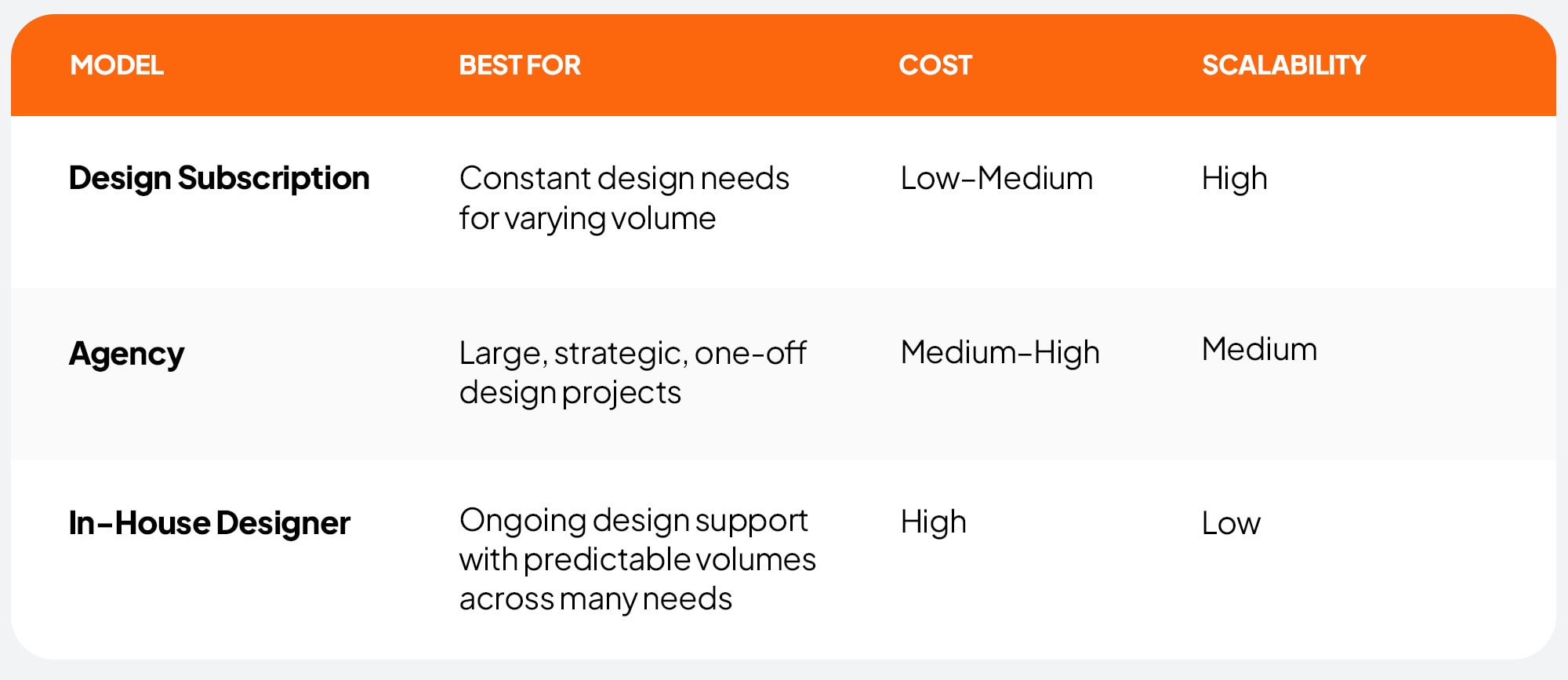
Design subscription vs agency vs in-house: full comparison
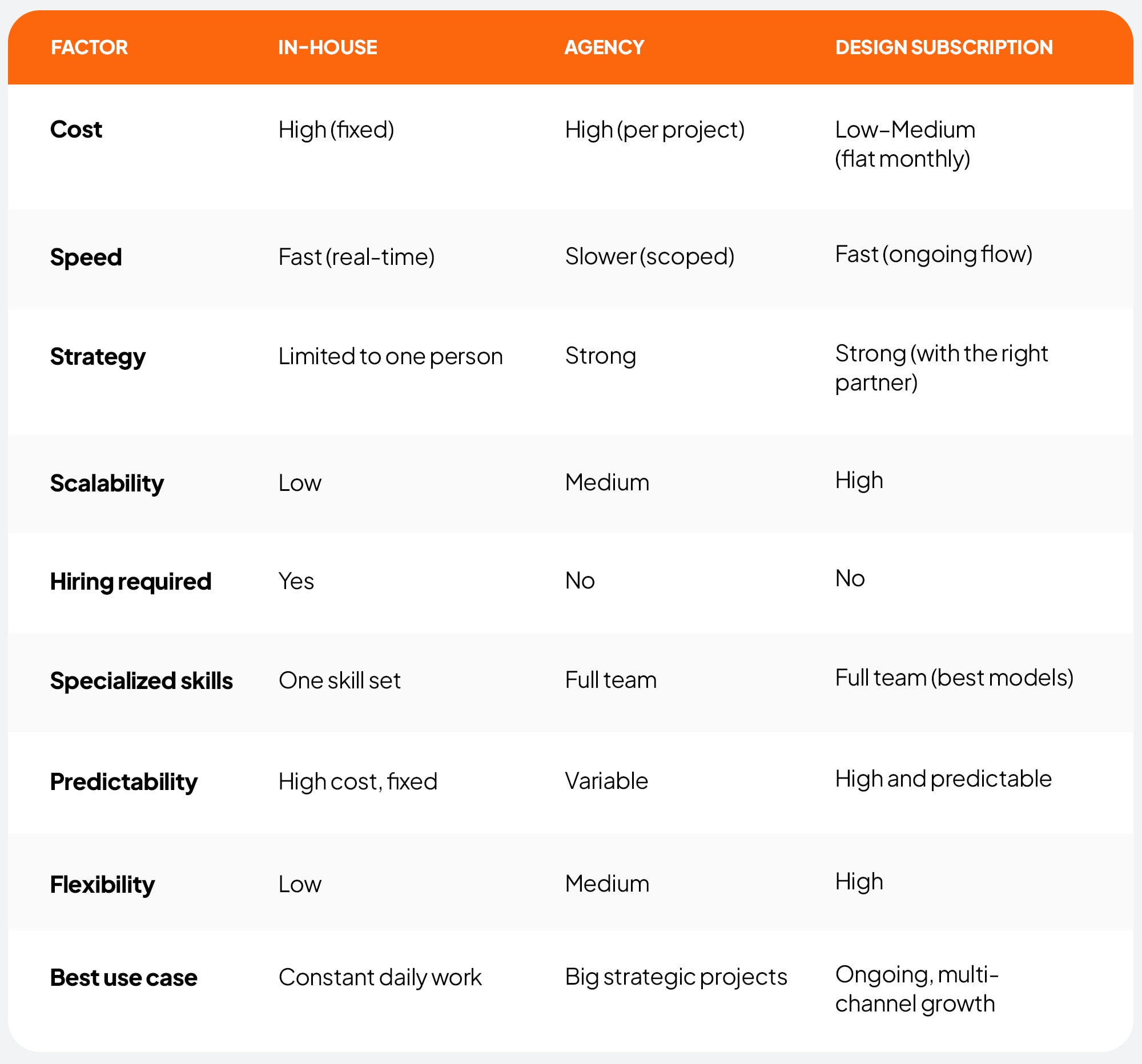
No model wins every row–and that’s the point. The smartest choice isn’t the cheapest or the most prestigious. It’s the one that matches how your business actually creates and grows.
Best design subscription for startups
Startups feel the creative bottleneck first and hardest. You’re trying to look established before you are, move fast on a tight budget, and build a brand that earns trust–all at once.
What startups actually need
- Credibility. Investors, customers, and partners judge you on how you show up. Looking small kills momentum.
- Flexibility. Your priorities shift weekly. Your creative support has to shift with them.
- Speed. When the window opens, you have to move–not wait three weeks for a quote.
Why so many startups hire too early
The instinct is to hire a designer the moment things get busy. But early-stage needs are wide and shallow–a bit of brand, a bit of web, a bit of pitch deck, a bit of social. No single hire covers that spread well, and you end up paying a full salary for partial coverage while still outsourcing everything your one designer can’t do.
That first hire often arrives a year too early and leaves a hole in the runway.
The better alternative
Fractional creative support. Instead of one early hire, you get a senior-led team across branding, web, and marketing–for a fraction of the cost, with none of the management burden. You get the range of an agency, the steadiness of an employee, and the flexibility to scale only when you’re truly ready to. For most startups, this is the model that buys both quality and runway.
Which Creative Model Is Best for Your Business Stage?
Your stage should decide your model. Here’s the short version:
Startup–Design subscription. You need range, speed, and credibility on a budget. A fractional creative subscription delivers all three without a premature hire.
SMB–Design subscription + strategic in-house. As you grow, you need ongoing creative and someone helping steer brand decisions. A subscription paired with senior strategic guidance keeps you sharp and consistent.
Marketing team–Design subscription. Internal marketers move fast and constantly run out of creative hands. A fractional team plugs in as an extension of yours–execution power without new headcount.
Enterprise–Design subscription + in-house team. Large organizations usually run a mix: an in-house team for daily and governance-heavy work, plus agencies and subscriptions for surges, specialized projects, and outside perspective.
R1 Creative vs design factory services vs agencies vs freelancers
How do these outsourcing options stack up? Here’s a fair look at each–strengths and tradeoffs.
Freelancers
Pros: Affordable, flexible, easy to start. Great for a single, well-defined task.
Cons: Reliability varies, availability is never guaranteed, and quality swings from one hire to the next. There’s no team behind them and no strategy baked in. When you grow, you end up managing a roster of freelancers–which becomes its own full-time job.
Design factory services
Design factory services such as Design Pickle are production houses designed to deliver a high volume of design work at an affordable monthly cost. To achieve that scale and price point, however, the focus is typically on efficient output rather than quality and deep creative partnership.
Pros: Queue-based subscription services are strong for high-volume, lower-complexity marketing graphics at a flat monthly rate. Simple to use when you just need a steady stream of assets.
Cons: Built for output, not strategy. Rotating designers make brand continuity harder, and the model isn’t designed for deep branding, web, or the senior creative direction that growing businesses need.
Traditional agencies
Pros: Serious strategic and creative depth. The right call for major, brand-defining projects with the budget to match.
Cons: Expensive per project, slower to engage, and awkward for the ongoing, week-to-week work that actually drives growth. Bigger shops can also feel impersonal once the contract is signed.
R1 Creative
Most growing businesses don’t need another vendor. They need a creative partner that understands their business, protects their brand, and helps them execute consistently as they grow.
That’s where a fractional creative team comes in.
R1 Creative combines the strategic thinking of an agency, the familiarity of an in-house team, and the flexibility of a subscription model. Instead of managing freelancers, navigating agency overhead, or relying on a queue-based design service, you gain a dedicated creative partner invested in your long-term success.
Pros:
- Strategy-first we start with your business goals, not your color palette
- Founder involvement senior creatives, actually in the work
- Boutique partnership you’re a partner, not a ticket number
- Subscription flexibility scale up, scale down, stay predictable
- Branding expertise built to define brands, not just decorate them
- Web expertise design that converts, not just looks good
- Marketing creative the steady, multi-channel work growth depends on
- Dedicated project management nothing falls through the cracks
- Curated specialists the right talent for each project, on tap
We’re not a design factory. We’re not a freelancer. We’re not a bloated agency.
We’re a fractional creative team built for growth–the depth of an agency, the steadiness of an in-house team, and the flexibility of a subscription, all in one partner.
The R1 Creative point of view
Most businesses start with the wrong question: “Who should design this?”
The better question is: “How do we build creative capacity?”
Because design isn’t a project you finish. It’s an operational function you build–as essential to growth as sales or product. Treat it like a one-off and you’ll always be scrambling to catch up to your own ambitions.
The companies growing fastest right now aren’t racing to hire huge internal creative teams. They’re building flexible creative ecosystems–senior strategy on demand, the right specialists for each job, and the ability to scale capacity up or down without rebuilding their org chart every quarter.
That’s why the future of creative isn’t agency, freelancer, or employee.
It’s the fractional creative team. A real partner who behaves like your creative department, grows with you, and connects every piece of work back to the only thing that matters: building your business.

Frequently asked questions
Is a design subscription better than hiring a designer? For most growing businesses, yes. A subscription gives you a full range of skills–brand, web, marketing–for less than a single salary, with the flexibility to scale up or down. Hiring wins only when your design workload is constant, high-volume, and predictable enough to keep one person fully busy every day.
What does a graphic designer cost? More than the salary. Once you add benefits, recruiting, software, training, and management time, a mid-to-senior designer realistically costs $85,000–$140,000+ per year–for one person and one skill set.
Are unlimited design subscriptions worth it? They’re worth it if you create regularly across multiple channels and want predictable costs. They’re not worth it for one-off needs like a single logo. The real value isn’t “unlimited” output–it’s reliable, on-brand creative from a team that knows your business.
What is the best design subscription for startups? The one that gives you range and strategy, not just volume. Startups need credibility, speed, and flexibility on a budget–which makes a senior-led fractional creative team a stronger fit than a queue-based service or a premature full-time hire.
When should I hire an in-house designer? When your design needs are constant, high-volume, and predictable enough to fill a full-time role every day–and when you have the management capacity to lead and grow that person. If your workload rises and falls with campaigns, a subscription is the smarter spend.
Is outsourcing design cheaper than hiring? Usually, yes–and not just on price. Outsourcing through a subscription removes recruiting, benefits, software, and management costs, while giving you a broader skill set than any single hire. You pay for capacity, not overhead.
What is a fractional creative team? A senior-led team–strategy, branding, web, and marketing creative–that works as an extension of your business for a flat monthly fee. You get the depth of an agency and the steadiness of an in-house team, without the cost or commitment of full-time hires.
How much should branding cost? It depends on scope. A focused brand identity might run a few thousand dollars; a full strategic rebrand can reach $50K or more at an agency. With a subscription model, branding becomes part of an ongoing partnership rather than a single large invoice, which is easier to manage as you grow.
Can a subscription replace an agency? For ongoing and mid-sized work, absolutely. The best subscription models bring agency-level strategy and execution to the everyday creative that drives growth. For rare, massive, brand-defining projects, a hybrid approach can still make sense.
What services are included? With R1 Creative, that means brand identity design, website design, marketing and campaign creative, pitch decks, and ongoing creative support–led by senior creatives, managed by a dedicated project lead, and backed by a curated network of specialists.
Build your creative team without building a department
Whether you’re deciding between hiring a designer, engaging an agency, or exploring a design subscription, the goal isn’t finding the cheapest option.
It’s finding the model that helps your business grow.
At R1 Creative, we help ambitious businesses access agency-level strategy, subscription flexibility, and dedicated partnership, without the full-time overhead. Brand identity, web, and marketing creative, all from one team that treats your growth like our own.
Ready to step your brand up? Start Your Project